
 Nikolas Fragkias

There is a moment every NLP Practitioner knows well.
The training is over. The certificate is in your hands. The photos have been taken, the hugs exchanged, the WhatsApp group created with promises to stay in touch.
And then Monday comes.
You sit with your certificate and a question quietly takes shape, one that no module of the training prepared you for:
What now?
The certificate is not the finish line
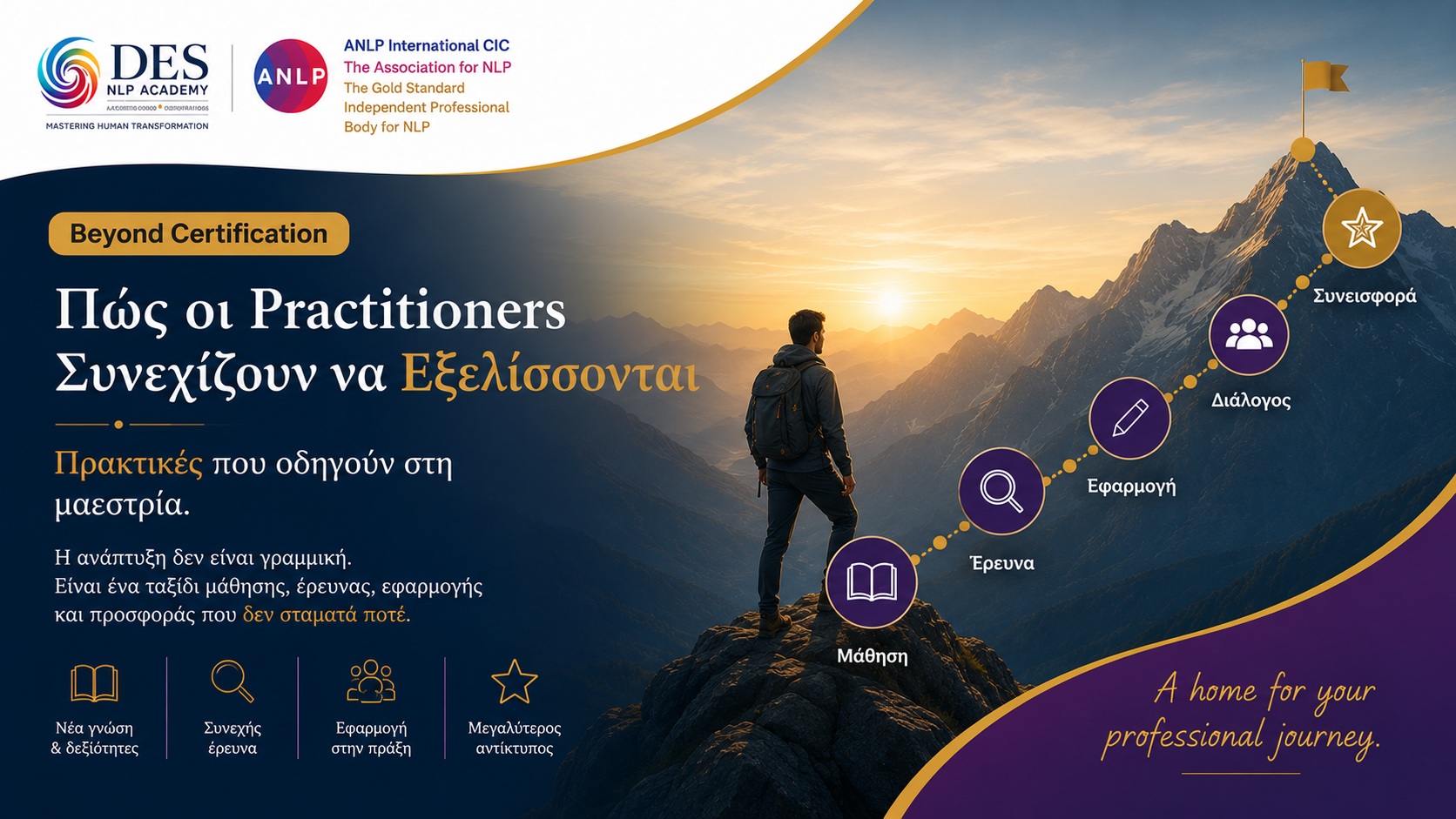
We treat certification as a destination. It isn’t. It is a threshold.
A Practitioner certificate shows that you have learned a set of skills and that you keep practising them. It says nothing yet about who you will become with them. Your training taught you to calibrate, to reframe, to anchor, to work with the structure of subjective experience. What it could not teach you is how to stand in the world as a professional: how to hold standards no one is checking, how to keep growing when no trainer is watching, how to belong to something larger than the room where you trained.
That is the difference between completing a training and stepping into something that has a profession behind it, and behind that, a quiet wish to be able to help people.
A training has a syllabus and an end date. A profession has ethics, a community and a lifetime.
My own path
My own road into NLP ran through INLPTA, an organisation I deeply respect and still represent through DES NLP Academy. In more than thirty years as a psychologist, behavioural analyst and executive coach, I have trained in different schools of psychology and of neuro-linguistic programming, worked with colleagues from different traditions, and watched outstanding practitioners emerge from all of them.
And what I noticed is that it had nothing to do with which school each of them came from.
The practitioners who flourished were not necessarily the ones with the most certificates. They were the ones who found a professional home: a place that held them to standards, connected them with colleagues and reminded them, in the lonely stretches every practice goes through, that they belonged somewhere.
The ones who struggled were often just as capable. They were simply alone.
Why I joined ANLP
That is why, when I talk about ANLP, the Association for NLP, I want to be precise about what it is and what it isn’t.
ANLP is not another school. It does not compete with INLPTA, ABNLP or any other training organisation, and it is not another certifying board. It does not issue Practitioner certificates, and it does not claim that one tradition is superior to another.
It is something our field has needed for a long time: an independent professional body. A Code of Ethics you publicly commit to. A framework of professional standards. A quarterly magazine, Rapport, where practitioners publish, research and think together. A community of colleagues in dozens of countries who take the profession seriously enough to organise it.
In other words: not another place to train. A place to belong.
Medicine has its medical associations. Psychology has its societies. Coaching is building its federations. These structures exist because a profession is not the sum of its trainings; it is the community that holds the standard.
I joined ANLP, and accepted the role of International Ambassador for Greece, because I believe NLP in our country is ready for that maturity.
A question to stay with you
So I won’t leave you with an invitation, but with a question, the same one I once asked myself:
Where do you see your NLP journey taking you in the next five years?
If the honest answer includes more than collecting certificates, if it includes becoming a professional with everything that word carries, then the next question is where you will build your professional home. (A complex equivalence, for the NLPers among us.)
I will explore this question throughout this series, because I owe it to myself and certainly to everyone who has travelled into the world of NLP. In the next article: what really happens after certification, the part nobody talks about.
An open door
If you want a professional body with a global reach behind your NLP practice, you can explore ANLP membership at anlp.org/become-a-member. Read Rapport. Look at the research. Meet the international community. See the Code of Ethics and the professional framework for yourself. Then decide, fully informed, whether this is your professional home.
No obligation. No small print. Just an open door.
If you would like to talk it through, get in touch with us.
Nikolas Fragkias is a psychologist, behavioural analyst and executive coach, ANLP International Ambassador and INLPTA National Coordinator for Greece.