
 Nikolas Fragkias

Nobody warns you about the silence.
During your training, you were surrounded. Exercises in triads. Feedback within minutes. A trainer who could answer every question. A room full of people who spoke your new language (anchors, submodalities, well-formed outcomes) without needing a translation.
Then the training ends. And for the first time since you started, you are practising alone.
This is the part of the journey nobody puts in the brochure. So let’s talk about it honestly.
The voice that says “who am I to do this?”
Almost every newly certified Practitioner I have met in thirty years of practice, including, once, myself, has heard some version of this voice.
The certificate says Practitioner. But am I really?
I want you to know something: that voice is not evidence of a problem. It is evidence of seriousness. Practitioners who worry whether they are good enough are almost always the ones who care enough to become excellent. The dangerous ones are those who never ask. (I could, of course, also analyse the “non-convincer” types, for whom nothing is ever enough.)
But there is a trap. That voice shrinks inside a community and grows in isolation. On your own you have no reference points, no way of discovering that the experienced colleague you admire once stood exactly where you stand now. Within a community, the voice becomes what it was meant to be: a compass pointing towards growth, not a wall blocking the road.
The first clients
Then come the first real sessions. Not exercises with fellow trainees who want you to succeed (bless them), but real people, with real stakes, who have not read the manual.
And with them come real questions your training could not fully prepare you for. What do I do when a client brings something beyond what I know? How do I set up a clear working agreement? Where are my ethical boundaries, not in theory, but on a Tuesday afternoon with a person sitting across from me?
These are not questions of knowledge. They are questions of profession. And questions of profession need more than a manual: they need a code of ethics you have committed to, colleagues to think with, and somewhere to turn when the answer is not obvious.
What growth really looks like
This is where many practitioners make an understandable mistake: they read their discomfort as a signal to sign up for another seminar.
Sometimes it is. More often, though, what the discomfort is asking for is not more training but more practice and professionalism. Structure around your practice. Rhythm. Colleagues. Standards. Fresh thinking that arrives regularly, whether you went looking for it or not.
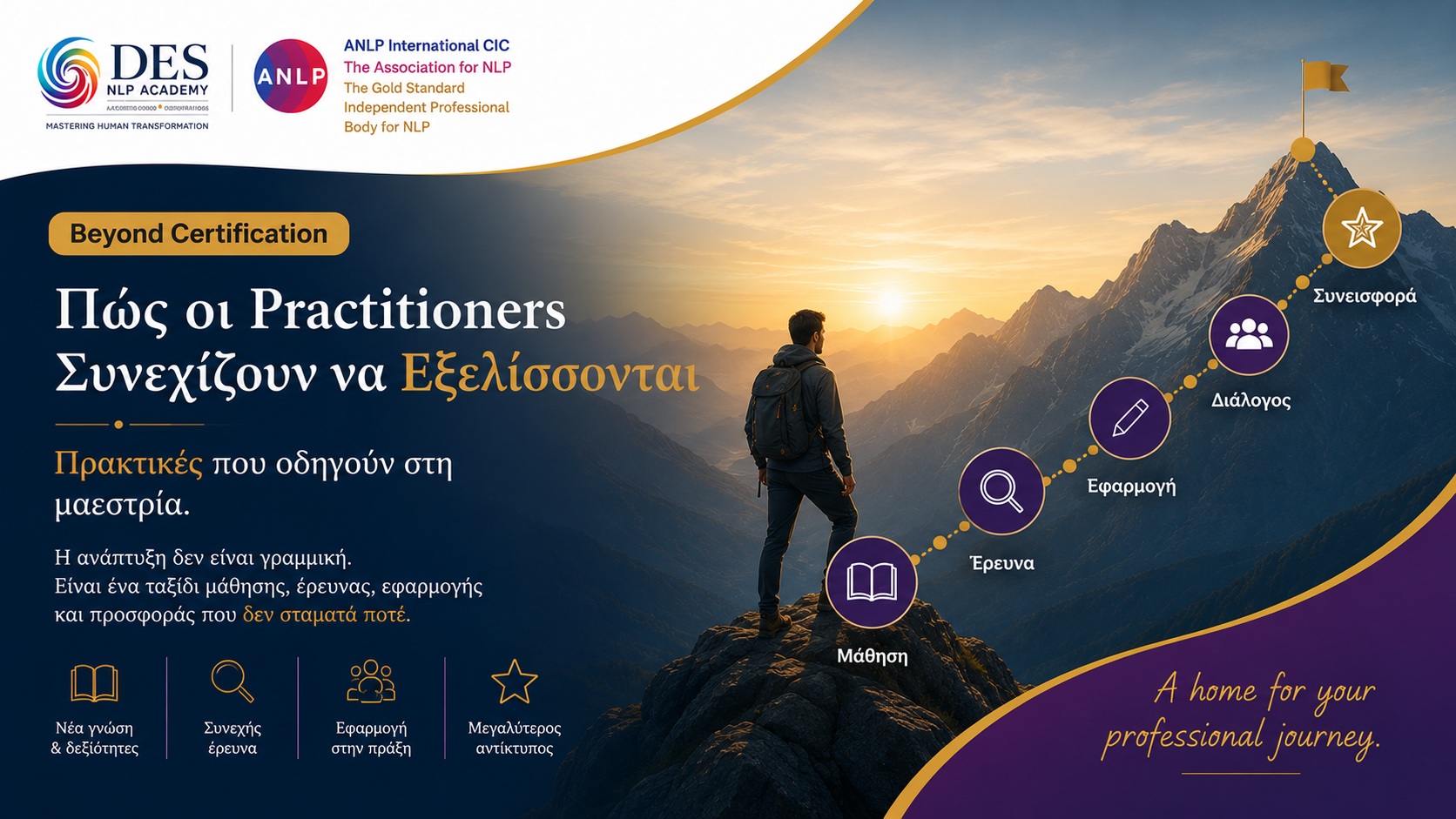
Let me describe what that looks like inside a professional body, because before I joined ANLP, I could not picture it clearly either.
Every quarter, Rapport, the association’s magazine, arrives with case studies, research and the thinking of practitioners from around the world. You read how a colleague in another country handled exactly the situation that challenged you last month. You find Special Interest Groups where people in your own field (education, therapy, business) exchange experience. You realise that the question you were embarrassed to ask has an entire discussion devoted to it.
And something quietly shifts. You stop being someone who once attended a training. You start being a member of a profession.
Loneliness does not survive that shift.
The open door, again
If you read my first article, you know where I stand. You can explore ANLP membership at anlp.org/become-a-member. Read Rapport. Look at the research. Meet the international community. See the Code of Ethics and the professional framework for yourself. Then decide, fully informed, whether this is your professional home.
No obligation. No small print. Just an open door.
If you would like to talk it through, get in touch with us.
Nikolas Fragkias is a psychologist, behavioural analyst and executive coach, ANLP International Ambassador and INLPTA National Coordinator for Greece.